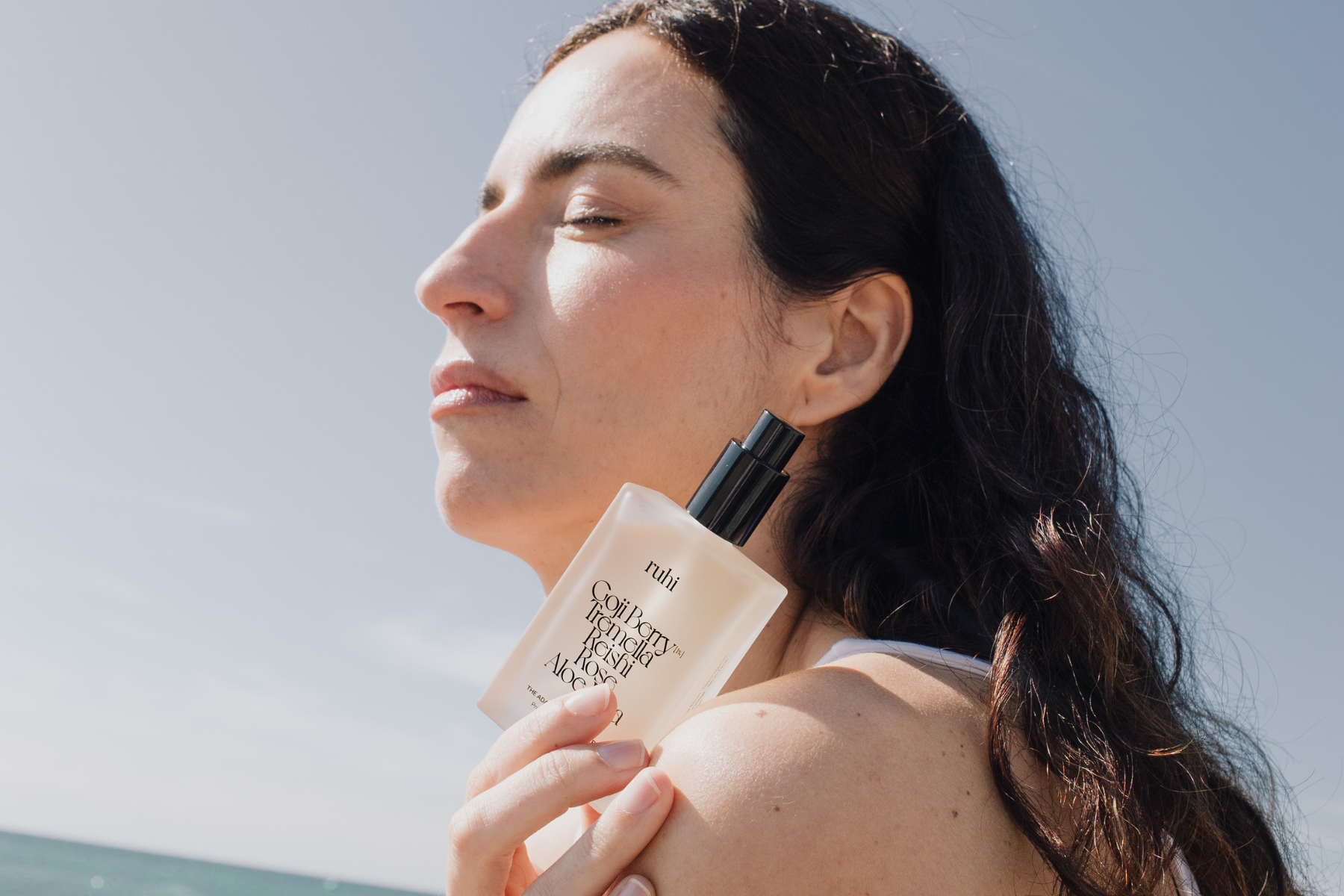

They are usually harmless, but often cosmetically bothersome – we are talking about pigment spots. Many people want to get rid of hyperpigmentation, especially on the face, neck, and décolleté, as quickly as possible.
But is it even possible to remove pigment spots? How exactly does hyperpigmentation occur? And can pigment spots be prevented? You will find answers to these and many more questions in the following article.
What are pigment spots?
In medicine, the term pigment spots summarizes all types of altered skin coloration (pigmentation). These are usually brownish, often also reddish or ochre-colored spots that are not raised. In most cases, these discolorations are harmless, often disappear on their own, and do not require treatment.
Three forms of hyperpigmentation
The following three forms of hyperpigmentation are distinguished:
Sunspots and age spots
Sunspots often appear on areas exposed to light (e.g., on the face or neck). The small spots are also called age spots because they occur more frequently after the age of 40.
With age, the number of melanocytes, i.e., the cells responsible for producing the skin pigment melanin, decreases. The remaining cells work increasingly uncontrollably, which leads to darker skin areas in certain spots.
Melasma
Melasma refers to larger pigment spots that primarily appear on the face. These are usually hormonally induced. An excess of the female sex hormones estrogen and progesterone leads to an overproduction of melatonin. Sun exposure then does the rest and causes the dark spots to appear.
Post-inflammatory hyperpigmentation
Injuries and skin inflammation can lead to post-inflammatory hyperpigmentation. The skin produces an excessive amount of melanocytes in the affected area, causing the wounded area to discolor and darken.
What causes pigment spots and how do they form?
Pigment spots can have many causes. You will learn what these are and how they form in the following.
Causes of pigment spots
One of the main causes of hyperpigmentation is strong sun exposure and the resulting excessive binding of the skin pigment melanin. Other causes can be, as already mentioned, a hormonal imbalance (for example, during pregnancy or as a result of taking hormonal contraceptives), burns, various diseases or medications, but also a vitamin deficiency.
Formation
Pigment spots form on the epidermis, the outermost layer of the skin. They are caused by UVB rays. Sunlight promotes the production of the skin pigment melanin, which primarily serves as skin protection.
If melanin production increases, pigment spots can occur. In addition, oxidative stress, caused by both UVA and UVB radiation, promotes the development of hyperpigmentation. [1]
How can I prevent pigment spots?
The good news: Preventing pigment spots is not too complicated and primarily requires consistent sun protection – yes, even in winter months.
Avoid strong sun exposure
Especially in summer, you should avoid the midday sun between 11 AM and 3 PM. In addition, sunbathing for several hours is taboo if you want to prevent pigment spots. A sun hat protects your face, neck, and décolleté from excessive sun exposure.
Use SPF
In the summer months, we recommend regular application of high-quality sunscreen. And even in winter, you should protect your skin from the sun daily. Sun protection with an SPF of at least 30 is essential to prevent hyperpigmentation and sun-related skin damage.
So we can summarize: Adequate protection from UV radiation is indeed the most effective way to prevent hyperpigmentation. Without high-quality sun protection, no treatment will be permanently effective. You can remove pigment spots, but they will reappear if you do not protect yourself sufficiently from the sun.
How can I treat pigment spots?
Fortunately, existing pigment spots can be treated in various ways. Before we show you which active ingredients you can use to treat hyperpigmentation, we would also like to briefly discuss the other forms of treatment.
Laser treatment for pigment spots
Laser therapy is performed by a dermatologist. High-energy laser light breaks down pigment accumulations, which are then disposed of by the body's immune system.
Peelings against pigment spots
This form of pigment spot treatment is also performed by a dermatologist. Chemical substances such as fruit acid or trichloroacetic acid are applied to the affected areas. The uppermost skin layers with the pigment accumulations then peel off, and new, light skin can grow.
Treating pigment spots with vitamin C
Both laser therapy and chemical peeling place a greater strain on the skin. Since we are big fans of holistic skincare with natural active ingredients, we would like to recommend the gentle treatment of pigment spots with vitamin C.
Vitamin C is not only essential for our immune system – when applied externally, it is also effective against pigment spots. However, you should note that not every form of the popular vitamin has the desired effect. For the best brightening effect, we recommend using pure ascorbic acid or (even better) Vitamin C Tetra. This is because pure ascorbic acid is very sensitive and unstable, and quickly loses its effectiveness if stored incorrectly or for too long. At the same time, pure ascorbic acid in higher, effective concentrations can irritate sensitive skin.
Vitamin C Tetra against pigment spots
Vitamin C Tetra, also known as Ascorbyl Tetraisopalmitate (ATIP for short), is a new, very potent form of Vitamin C that penetrates particularly deeply into the skin. It effectively protects the skin from UV damage and also reduces pigment spots due to its brightening effect. In addition, Vitamin C Tetra stimulates collagen production and minimizes fine lines and wrinkles. At the same time, Vitamin C Tetra – in contrast to common ascorbic acid – is a very mild Vitamin C variant that does not irritate the skin and is therefore particularly well suited for sensitive skin.

Studies confirm the effect of Vitamin C Tetra
The brightening effects of ATIP were investigated in a clinical study in Tokyo. Over 56 days, UV-induced pigment spots were treated daily with Vitamin C Tetra (2%). After the test period, the hyperpigmentation was almost no longer visible. In the same study, a 16-week treatment with 10% Vitamin C Tetra led to the complete removal of significant age spots. [2] Another clinical study from 2018 came to the same conclusion. [3]
But what comes next is truly astonishing: Vitamin C Tetra is not only capable of reducing or completely reversing hyperpigmentation. Further scientific results show that ATIP in a 3% dosage can even prevent UVB-induced hyperpigmentation, meaning it has a preventive effect. [4]
In Japan, Vitamin C Tetra is considered a medicinal ingredient
Ascorbyl Tetraisopalmitate is particularly popular in Asia: at a dosage of 2% or more, it is sold as a lightening agent in South Korea. In Japan, products with 3% Ascorbyl Tetraisopalmitate are considered medicine. You see: Vitamin C Tetra is a truly effective remedy against hyperpigmentation. [5]
Our Adaptogen Vitamin C Oil Serum contains 15% Vitamin C Tetra. With this high dosage of the active ingredient, you can wonderfully use the serum to treat pigment spots.
In addition, it contains other powerful ingredients such as astaxanthin, organic gotu kola, organic ginkgo, organic plum kernel oil, organic squalane, and natural vitamin E. The serum is a real powerhouse of active ingredients
- for protection,
- for brightening and
- firming the skin.
Finally, an important note: Vitamin C Tetra does not provide sufficient sun protection, although it has been shown to protect the skin from UV radiation. You should always protect yourself additionally from harmful UVA and UVB rays by regularly applying sunscreen and avoiding the midday sun.
Do you have any questions? Feel free to contact us at any time.
SOURCES
[1] Mahmoud, BH., Ruvolo, E., Hexsel, CL., Liu, Y., Owen, MR., Kollias, N., et al. Impact of long-wavelength UVA and visible light on melanocompetent skin. J Invest Dermatol. 2010;130(8):2092–2097. doi: 10.1038/jid.2010.95. https://pubmed.ncbi.nlm.nih.gov/20410914/
[2] Nikko Chemicals Co., Ltd.. Oil-Soluble Vitamin C Derivative. https://www.chemical‐navi.com/english/index.html
[3] Sundarman, H./ Nachtweide, D. et al. (2018): Pilot evaluation of safety, efficacy, and tolerability of a new topical formulation for facial hyperpigmentation, combining ascorbyl tetraisopalmitate and crosslinked resilient hyaluronic acid, in: Journal of the American Academy of Dermatology, Vol 79(3). https://www.jaad.org/article/S0190-9622(18)31686-4/fulltext
[4] Ochiai, Y./Kaburagi, K. (2006): A new lipophilic pro-vitamin C, tetra-isopalmitoyl ascorbic acid (VC-IP), prevents UV-induced skin pigmentation through its anti-oxidative properties, in: Journal of dermatological science, 44(1):37-44. https://pubmed.ncbi.nlm.nih.gov/16935471/
[5] Bastianini, M.; Sisani, M. et al. (2017): Ascorbyl Tetraisopalmitate Inclusion into Υ-Cyclodextrin and Mesoporous SBA-15: Preparation, Characterization and In Vitro Release Study, in: Cosmetics, 4(3): 21. https://www.mdpi.com/2079-9284/4/3/21/htm