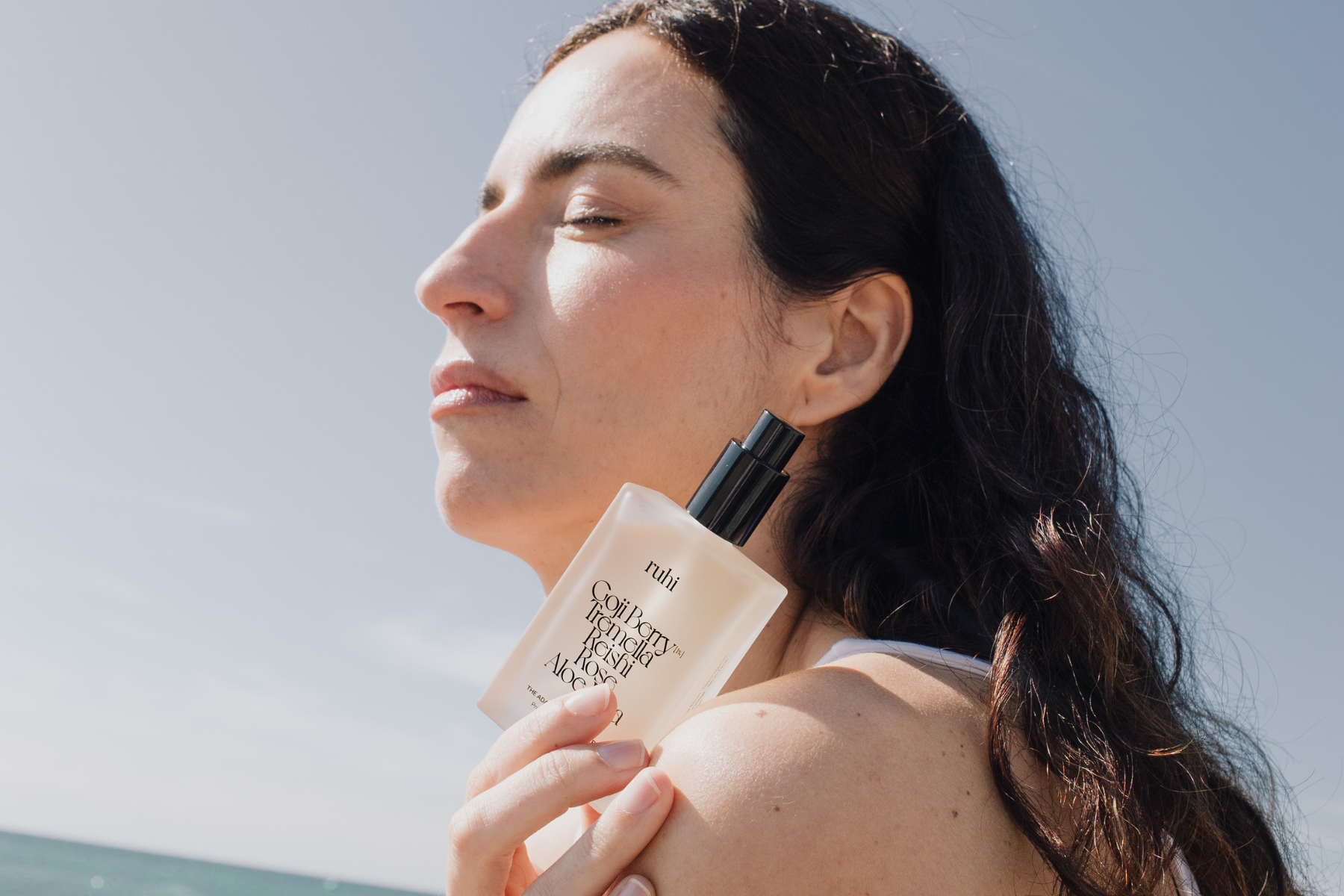

Mineral sunscreens are enjoying increasing popularity. So it's high time to take a closer look at them.
We'll examine how mineral sun protection works, what differentiates it from conventional sunscreens, and conduct a quick fact-check on persistent sun protection myths.
Last but not least, we'll introduce you to our specially developed mineral sunscreen for the face. Let's go!
WHAT IS MINERAL SUNSCREEN?
Conventional and natural sunscreens primarily differ in the filters they contain, which are intended to protect the skin from UV radiation:
- Organic or chemical filters are used in conventional sunscreens and consist of synthetic molecules. They absorb UV radiation and convert it into heat radiation.
- Mineral or physical filters consist of the minerals zinc oxide or titanium dioxide. Only mineral filters are approved in natural cosmetics, as they are of natural origin and gentler on the skin.

SUNSCREEN MYTHS FACT-CHECKED
Many myths surround sun protection in general and mineral sunscreens in particular. Let's take this opportunity to clear up three of the most common "tall tales" on this topic:
Myth 1: Mineral sunscreen only reflects radiation instead of absorbing it
It's true that mineral sunscreens with zinc oxide or titanium dioxide form a physical barrier that deflects and scatters UV rays from the skin.
However, studies show that these ingredients can also absorb some UV radiation and convert it into heat [1], which contributes to their overall effectiveness and provides broad protection against both UVA and UVB rays. Furthermore, mineral sunscreens soothe the skin and reduce the risk of irritation.
Myth 2: Sunscreen prevents vitamin D absorption
While sunscreen does block some UVB rays responsible for vitamin D production in the skin, it doesn't block them completely.
Studies show that even with consistent sunscreen use, enough UVB radiation still reaches the skin to stimulate vitamin D synthesis. [2] Additionally, vitamin D can also be easily supplemented, which further relativizes the effect of sun protection products on vitamin D levels.
Myth 3: You only need sunscreen in summer
Far from it! While the intensity of UVA radiation varies throughout the day and year, it is consistently present all year round, even in the less sunny autumn and winter months.
[3] This is because, unlike UVB radiation, it is not blocked by the ozone layer, cloudy skies, and window glass, which means UVA rays account for 95% of all UV radiation. [4] Without sunscreen, your skin is thus exposed to UVA radiation daily without protection, and photodamage accumulates over the years.
WHAT YOU SHOULD GENERALLY LOOK FOR IN SUNSCREEN
The range of sunscreens is vast. Whether you use mineral or chemical sunscreen, you can use these criteria to guide your search for a safe product:
No hormonal effect
Some chemical filters are suspected of having hormonal effects, which is not the case with mineral filters.
Broad-spectrum protection
Sunscreen should provide effective protection against both UVA and UVB rays. Both synthetic and natural sunscreens meet this criterion.
No nanoparticles
Mineral filters are also sometimes offered in nano-form. However, these tiny particles may be able to penetrate the skin and enter the body, posing health risks. [5]
Low allergy potential
Mineral sunscreens contain no chemical filters and are therefore gentler on the skin and less irritating. They are therefore particularly suitable for sensitive skin, children and pregnant women, and people with skin conditions.
No titanium dioxide
This mineral is still permitted in natural sunscreens, as it has so far been considered harmless when not used in nano-form. [6] However, it is controversial and already banned in food products. We therefore clearly prefer zinc oxide as a UV filter.
RUHI MINERAL SUNSCREEN: THE ADAPTOGEN MINERAL SUNSCREEN FACE SPF 50
As declared natural cosmetics fans, we were often asked: "Can you recommend a good, natural sunscreen?" And the answer was not so simple, because none of the alternatives to conventional sun protection had truly convinced us until then.
Many natural cosmetic products leave a strong white film on the skin or do not offer sufficiently high protection. This prompted us at ruhi to take action ourselves and find a solution that offers both a high protection factor and is pleasant to use.
The result is "The Adaptogen Mineral Sunscreen Face SPF 50". A natural, purely mineral slow-aging facial sunscreen with SPF 50, which, thanks to its invisible tint, completely avoids a white cast.
A safe bet: SPF 50
The sun protection factor (SPF) indicates the level of protection against UVB radiation. This radiation is responsible for skin tanning and thus for sunburn and associated skin damage. UVB rays also damage cell DNA and are therefore involved in the development of skin cancer.
An SPF of at least 30 or higher helps minimize these risks. In addition, current studies show that most people often apply only half of the recommended amount of sunscreen, which significantly reduces its protective effect. [7] Our natural sunscreen has a high protection factor of SPF 50, putting you on the safe side.
High UVA protection supports slow-aging
UVA rays penetrate deeper into the skin than UVB rays and are therefore primarily responsible for premature skin aging. [8] High protection against UVA radiation is thus the best slow-aging measure. The broad-spectrum protection of our mineral sunscreen therefore offers not only UVB protection with SPF 50 but also effective protection against UVA radiation.
The legally required UVA value in sunscreens is 30% of the UVB protection. The UVA protection in our Adaptogen Mineral Sunscreen is 21.5. This corresponds to 43% of the UVB value and thus even exceeds the minimum value specified in the Cosmetics Regulation.
Antioxidants for even better sun protection
Among the hero ingredients of our natural sunscreen are three highly effective antioxidants. These play a crucial role in improving the protective effect of sunscreens. [9] Antioxidants scavenge free radicals that are generated in the skin by UV radiation.
These free radicals can cause cell damage and promote premature skin aging. Antioxidants such as vitamin E [10], blueberry [11], and green tea extract [12] neutralize these free radicals and provide additional protection beyond simply filtering UV rays.
They work synergistically with the sunscreen filters and strengthen the skin's natural defenses, making it more resistant to external environmental influences. This double protection mechanism makes our mineral sunscreen with antioxidants particularly effective.

The Adaptogen Mineral Sunscreen Face SPF 50 from ruhi, €39 for 50ml.
What's inside: Our 6 hero ingredients
Non-Nano Zinc Oxide
Mineral broad-spectrum filter that protects against UVA and UVB radiation and leaves no white residue. Zinc oxide also has anti-inflammatory and skin-soothing properties.
Blueberry (Organic)
Strong antioxidant that protects against harmful environmental influences, thereby intensifying the effect of the sunscreen.
Green Tea (Organic)
Also a strong antioxidant that protects against free radicals, prevents premature skin aging, and enhances the protective effect of sunscreen.
Natural Vitamin E
As a potent antioxidant, it strengthens the skin barrier and supports the sunscreen's effect by protecting against negative environmental factors.
Snow Mushroom
A botanical form of hyaluronic acid that binds moisture in the skin.
Allantoin
Plant-based active ingredient that stimulates healing processes in the skin, soothes, and regenerates it.
Tips for applying our mineral sunscreen
When and how much sun protection should be used? And in what order should day cream, sunscreen, and makeup be applied most effectively? Here are the answers:
- When? Always use the sunscreen in the morning after applying your moisturizer, as the last step in your skincare ritual.
- How? Apply a generous amount to your face, neck, and décolleté and gently massage it in with circular motions, avoiding eye contact. For constant protection, reapply several times during prolonged sun exposure, heavy sweating, and after swimming and drying off.
- Sunscreen first or makeup? Ideally, apply your foundation or makeup over the sunscreen. Let the sunscreen absorb well so it can develop its full effectiveness and not mix with your makeup.
Important! Even the best sunscreen with a high SPF does not provide 100% protection against harmful UV rays. Therefore, you should not spend too much time in the sun and avoid direct sunlight as much as possible. For the protection of delicate facial skin, a sun hat or cap is always a good choice.
8 Benefits of Our Facial Sunscreen
- High protection with mineral SPF 50
- Free from questionable ingredients like nanoparticles
- Contains only natural and vegan ingredients
- Offers additional protection through powerful adaptogens and antioxidants
- Ideal for sensitive, mature, or dry skin
- No white cast or greasy shine
- Instead, a silky-matte finish
- With a delicate tint that adapts to every skin type
OUR CONCLUSION: MINERAL SUNSCREEN IS THE BETTER CHOICE
As you may have noticed, the question of better sun protection is not so much about effectiveness as it is about your personal preferences. Because generally speaking: the best sun protection is the one you actually use. If you want an ultra-light, completely invisible fluid, then you can't get around chemical filters.
However, since some of these UV filters are suspected of having hormonal effects, we prefer the mineral version. It has the same broad-spectrum protection as conventional sunscreen, but is much gentler on the skin.
Our new Adaptogen Mineral Sunscreen is particularly pleasant on the skin, does not leave a white cast, and also contains several valuable antioxidants that enhance the protective function and additionally provide an effective slow-aging effect.
SOURCES
[1] Metal oxide sunscreens protect skin by absorption, not by reflection or scattering
[2] The effect of sunscreen on vitamin D
[3] UVA1 is skin deep: molecular and clinical implications
[4] Human skin pigmentation as an adaptation to UV radiation
[5] Neuronal cytotoxicity and genotoxicity induced by zinc oxide nanoparticles
[6] Titanium dioxide – are there health risks?
[7] Sunscreen Application, Safety, and Sun Protection: The Evidence
[8] Ultraviolet Radiation, Aging and the Skin: Prevention of Damage by Topical cAMP Manipulation
[9] Antioxidants in Sunscreens: Which and What For?
[10] Photoprotective actions of topically applied vitamin E
[11] Blueberry Supplementation and Skin Health