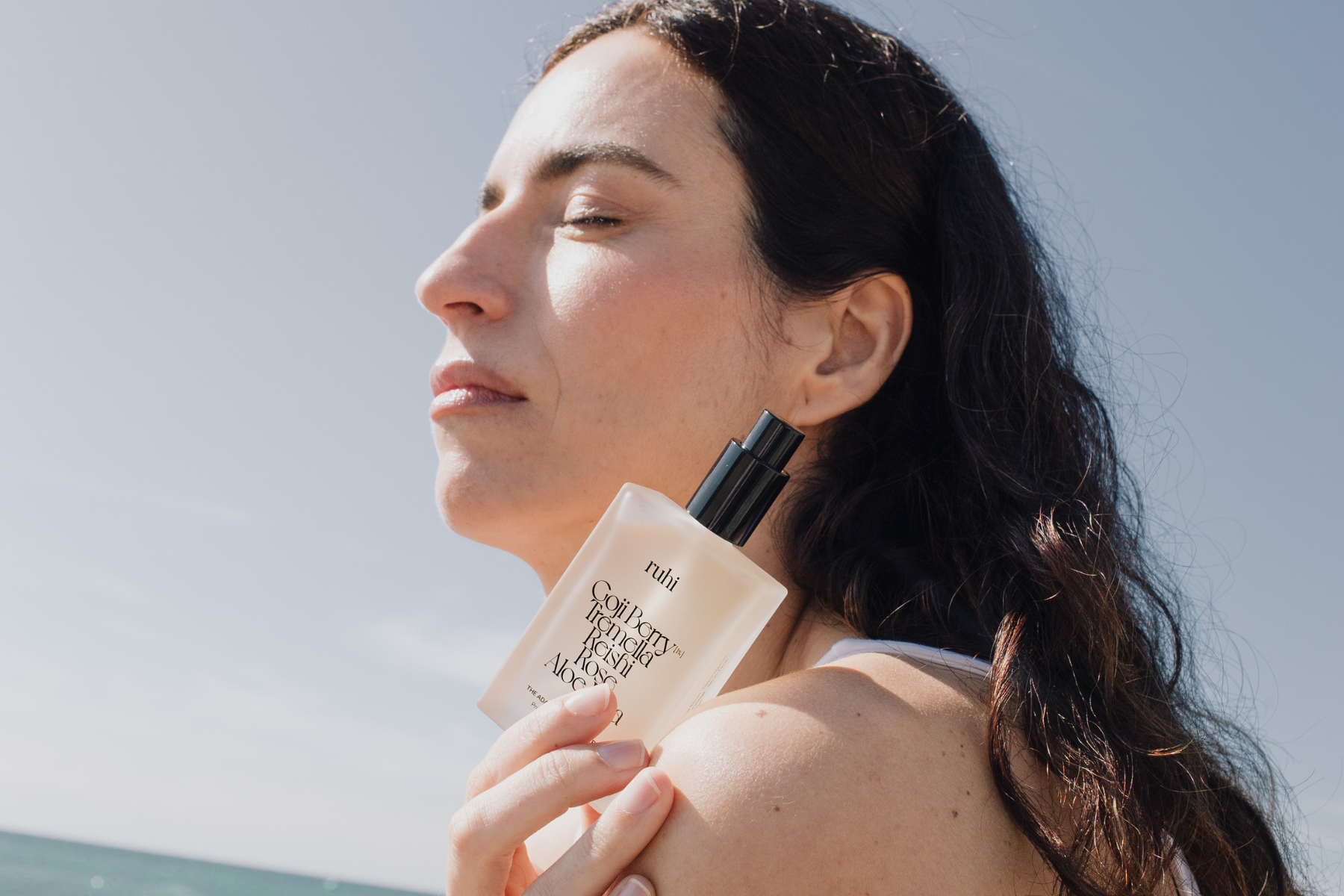

Tighten, balance, protect: Vitamin C for the face is said to have several benefits for your complexion. More and more manufacturers are now bringing vitamin C serums to the market. However, these differ not only in the vitamin C concentration they contain, but also in the vitamin C variant used.
Because: not all vitamin C is created equal! Read here why some vitamin C forms work better and which are particularly recommended for sensitive skin.
Vitamin C for the face: What does your skin get from it?
Vitamin C is a very popular active ingredient in skincare products. No wonder: this vitamin is a true multitasker and offers several benefits for your skin. The brightening, firming and antioxidant, i.e. skin-protecting, effect of topically applied vitamin C is now well researched and proven. [1]
This is what vitamin C does to your skin:
Brightening effect
Uneven skin tone? Vitamin C helps reduce dark spots on the skin. These can be pigment spots or post-inflammatory hyperpigmentation, which are harmless to health but annoy many due to the color deviation.
Vitamin C inhibits the activity of the enzyme tyrosinase, which is involved in the production of melanin. Melanin is a pigment responsible for our skin color. By inhibiting melanin production, vitamin C helps you achieve an even skin tone and improve the appearance of dark spots and age spots.
Collagen support
You may already know that vitamin C has a brightening and skin tone-balancing effect, as this is how the active ingredient is mostly advertised. But vitamin C can do much more than that! The active ingredient plays an important role in your skin's collagen production and is therefore partly responsible for its firmness and elasticity.
Collagen is a protein responsible for your skin's elasticity. As we age, the skin's natural collagen production decreases, which can lead to wrinkles and sagging skin.
Vitamin C is involved in regulating the enzymes responsible for collagen formation. It helps stabilize collagen strands by participating in the hydroxylation of the amino acids proline and lysine. This hydroxylation enables the formation of strong cross-links between individual collagen molecules, which are important for the strength and integrity of the tissue.
Antioxidant effect
Vitamin C is a powerful antioxidant that can protect your skin from harmful free radicals. Free radicals can damage skin cells and accelerate the aging process. They are caused by certain environmental influences, such as UV radiation or exhaust fumes in the air.
Vitamin C acts as an effective free radical scavenger for your skin and protects it from harmful influences. Less skin damage also means a younger, fresher complexion - and that's what we all want. A vitamin C serum is therefore a wonderful addition to your sunscreen, as the effective antioxidant can minimize UV damage.
Caution, oxidation: when vitamin C no longer works
As already listed, vitamin C for the face offers numerous benefits for your skin. However, there is a problem. The pure active ingredient is extremely unstable, which means its effect is easily lost. This means that the chemical structure of a vitamin C molecule changes very quickly if the optimal conditions are not met.
It becomes particularly problematic for pure vitamin C, also known as ascorbic acid, in aqueous solutions. Here, the active ingredient oxidizes in a very short time. Oxidized vitamin C loses its effectiveness and can even lead to irritation and redness. For this reason, you increasingly read about vitamin C creams and serums that advertise with the addition "water-free".
But water is not the only problem. The demanding vitamin C molecule also dislikes light and air and also reacts with oxidation and loss of effectiveness when exposed to sunlight and air. And apart from the instability described, pure vitamin C does not easily penetrate the fatty lipid layers of the skin because the active ingredient is water-soluble.
You see: it is not so easy to create skincare products with vitamin C that really benefit your skin. In other words: not everywhere where vitamin C is written, effective vitamin C is also contained!
How do you solve the problem? To increase stability and thus effectiveness, stabilized forms of vitamin C are often used in skincare, such as Ascorbyl Palmitate, Ascorbyl Glucoside or Ascorbyl Tetraisopalmitate, also known as Vitamin C Tetra. How do these forms differ? We will get to that now.
Vitamin C in skincare: these are the variants available

Those who want to use vitamin C for the face will encounter various forms of vitamin C used in creams and serums. These different variants are also referred to as vitamin C derivatives.
Let's take a look at the different forms before we choose the best one:
Ascorbic Acid (L-Ascorbic Acid)
Ascorbic acid is the purest and most biologically active form of vitamin C - but also by far the most unstable. Due to its instability, it can oxidize quickly, losing its effect. In addition, ascorbic acid can irritate your skin and is not recommended for sensitive skin types.
Ascorbyl Palmitate
Ascorbyl palmitate is a fat-soluble form of vitamin C. It is somewhat more stable than ascorbic acid and has a longer shelf life. However, according to current studies, it is nowhere near as effective as pure ascorbic acid.
Ascorbyl Glucoside
Ascorbyl glucoside is a relatively new, water-soluble derivative of vitamin C and also offers good stability. However, there are hardly any studies on its actual effectiveness.
Ascorbyl Tetraisopalmitate / Vitamin C Tetra
Ascorbyl Tetraisopalmitate, also known as Vitamin C Tetra, is an innovative fat-soluble form of vitamin C. It is considered very stable, well-tolerated, and at the same time highly effective.
Which vitamin C variant is recommended? A study from 2012 comparing the different vitamin C forms provides information on this.
Vitamin C Tetra: These are the advantages of this variant
In the aforementioned study, published in 2012 [3], Vitamin C Tetra particularly stood out.
In contrast to the also fat-soluble variant Ascorbyl Palmitate, Vitamin C Tetra demonstrably inhibits melanin production and thus also the new formation of dark spots. Thus, Vitamin C Tetra not only helps to dissolve existing hyperpigmentation, but also protects against the new formation of pigment spots. This was also confirmed by another study [4].
But not only that: Compared to the water-soluble form Ascorbyl Glucoside, the penetration ability of fat-soluble derivatives like Vitamin C Tetra is better. Due to its fat-soluble nature, Vitamin C Tetra can more easily penetrate the skin and be stored in the lipid structures of the skin cells.
In addition, Vitamin C Tetra offers a certain photoprotection against UV rays and thus minimizes cell damage that can be caused by sunlight. However, please do not skip your sunscreen and see Vitamin C Tetra more as a good supplement to further protect your facial skin from sunlight.
Last but not least, Vitamin C Tetra, just like potent ascorbic acid, is able to stimulate the skin's collagen production and can thus minimize wrinkles and fine lines.
Effective and at the same time gentle on the skin - Vitamin C Tetra seems to be the best choice for anyone looking for a gentle and effective vitamin C variant for the face.
Our Adaptogen Vitamin C Oil Serum contains 15% naturally derived Vitamin C Tetra, which protects, firms and shields your skin from hyperpigmentation. You can also use the serum to fade existing dark spots – without irritating or sensitizing the skin. Especially sensitive skin types benefit from this gentle care that makes the skin glow.
In addition to the innovative and effective Vitamin C Tetra, it also contains other purely vegan active ingredients that provide lasting care for your skin. These include organic ginkgo, organic gotu kola, and the carotenoid astaxanthin. Organic plum kernel oil and organic squalane provide an extra boost of care.
How to use the ruhi Adaptogen Vitamin C Oil Serum
It is best to apply the Adaptogen Vitamin C Oil Serum in the morning so that the powerful antioxidants can protect your skin from UV and environmental damage throughout the day. Since it is an oil-based product, we recommend applying it to slightly damp skin. This ensures optimal moisture retention and allows Vitamin C Tetra to penetrate the skin even better.
After cleansing your face, gently moisten your face with lukewarm water or spray on our Adaptogen Toner Serum. Then gently massage the Adaptogen Vitamin C Oil Serum into your skin. Done! It's that simple to give your skin an intensive yet gentle vitamin C treatment.
Should you have any further questions about vitamin C for the face, please do not hesitate to contact us.

Sources
[1] Topical Vitamin C and the Skin: Mechanisms of Action and Clinical Applications, 2017 https://www.ncbi.nlm.nih.gov/pmc/articles/PMC5605218/
[2] Assessment of penetration of Ascorbyl Tetraisopalmitate into biological membranes by molecular dynamics. 2016 https://www.sciencedirect.com/science/article/pii/S001048251630141X
[3] Stability, transdermal penetration, and cutaneous effects of ascorbic acid and its derivatives, 2012 https://pubmed.ncbi.nlm.nih.gov/23174055/
[4] Ascorbyl Tetraisopalmitate Inclusion into Υ-Cyclodextrin and Mesoporous SBA-15: Preparation, Characterization and In Vitro Release Study, in: Cosmetics, 4(3): 21. 2017, https://www.mdpi.com/2079-9284/4/3/21/htm