In the world of skincare, there's an endless selection of ingredients that promise to beautify our skin. One of the best-known and most commonly used active ingredients so far is retinol.
But now there's a new, rising star in the skincare sky: retinal. But what exactly are these two active ingredients and what distinguishes them? We'll tell you everything you need to know about retinal and its use in cosmetics and explain why retinal has what it takes to be the new must-have in your beauty routine.

WHAT IS RETINAL?
To understand why retinal is so special, we first need to clarify what retinoids are. Retinoids are a class of chemical compounds related to vitamin A. As so-called derivatives, i.e., modifications of vitamin A, retinoids have been used in dermatology and cosmetics for decades due to their numerous benefits for skin health.
Retinoids are still considered the absolute gold standard in anti-aging and slow-aging skincare: no other category of active ingredients is better researched; they are among the most potent anti-aging ingredients. The best-known retinoids include retinyl palmitate, retinol, retinaldehyde (short: retinal), and retinoic acid (also called tretinoin or vitamin A acid).
The Retinoid Family
Retinyl Palmitate:
This is the mildest form and is often found in skincare products for sensitive skin. It needs to be converted into retinoic acid in several steps, which greatly reduces its effectiveness.
Retinol:
The best-known retinoid so far with very good efficacy and therefore frequently included in cosmetic products. However, it still requires several conversion steps in the skin to become vitamin A acid and has a relatively high irritation potential.
Retinaldehyde (Retinal):
Only one intermediate step between retinol and retinoic acid in the metabolic pathway. Retinal is converted directly into retinoic acid in the skin and shows a much gentler effect than direct retinoic acid or retinol application.
Retinoic Acid (Tretinoin/Vitamin A Acid):
This is the strongest and most directly effective form of vitamin A. However, it is prescription-only and therefore not included in conventional skincare.
The Conversion Process of Retinoids in the Skin
To understand the differences between individual retinoids, it's important to know their conversion process in the skin until they finally become vitamin A acid:
- Retinyl palmitate is converted to retinol.
- Retinol is converted to retinaldehyde.
- Retinal is converted to retinoic acid.

Retinoic acid is the active form that directly affects skin cells. The fewer conversion steps required to reach this point, the more effective and faster the effect on the skin. This is a major advantage of retinal over retinol.
FIVE ADVANTAGES OF RETINAL OVER RETINOL
Shorter Conversion Time
Retinal requires only a single conversion step to become retinoic acid, whereas retinol is first converted to retinal and then to retinoic acid.
Faster Action
Due to its immediate conversion into the active form of vitamin A, retinal can be utilized more quickly by the skin. It acts almost 11 times faster [1] and shows visible results sooner than retinol, which takes longer to develop its effect due to the additional conversion step.
Stronger Efficacy
Retinal is not only superior in terms of speed of action, but also in terms of efficacy. It is not only faster but, according to current studies, also three times more biologically active than retinol, i.e., more effective. [2] The rule of thumb in this case is: the fewer conversion steps, the more effective.
Lower Amount of Active Ingredient Needed
The higher effectiveness of retinal means that, compared to retinol, a smaller concentration of the active ingredient is sufficient to achieve the same or better results.
Lower Irritation Potential
Studies have shown that the frequency of skin irritation with retinal is much lower. [3] Since it is converted into its active form more quickly, it has less time to cause irritation in the skin. Retinol, on the other hand, has a significantly higher irritation potential due to the longer conversion time and higher active ingredient concentration. In a comprehensive study with 229 participants, it was found that retinal, even in relatively high concentrations between 0.5 to 1%, is well tolerated by the majority of subjects. [2]
THE BENEFITS OF RETINAL IN SKINCARE
The efficacy of retinal is now supported by a multitude of scientific studies. Research into retinaldehyde in skincare has increased in recent years, as it is increasingly seen as the better alternative to retinol. [4] [5]. Clinical studies have shown, among other things, that retinal promotes collagen production, improves skin structure, and significantly reduces visible signs of skin aging.
Maximum Slow-Aging Effect:
Retinal supports collagen production in the skin, leading to improved skin elasticity and firmness. Fine lines and wrinkles are visibly reduced. [6]
Skin Renewal:
By promoting cell renewal, retinal helps to remove dead skin cells and creates a smoother, more even complexion.
Acne Control:
Retinal has anti-inflammatory properties that help combat acne. In addition, sebum production is reduced, which lessens the appearance of blackheads and pimples. [7]
Skin Brightening:
Retinal helps with hyperpigmentation by inhibiting melanin production. This leads to an even skin tone and minimizes age spots and sun damage. [8]
Relief from Rosacea:
Retinal shows positive effects in the treatment of rosacea by reducing inflammation and redness. [9]
Antioxidant Properties:
As an antioxidant, retinal protects the skin from harmful free radicals caused by environmental stressors such as UV radiation and pollution.

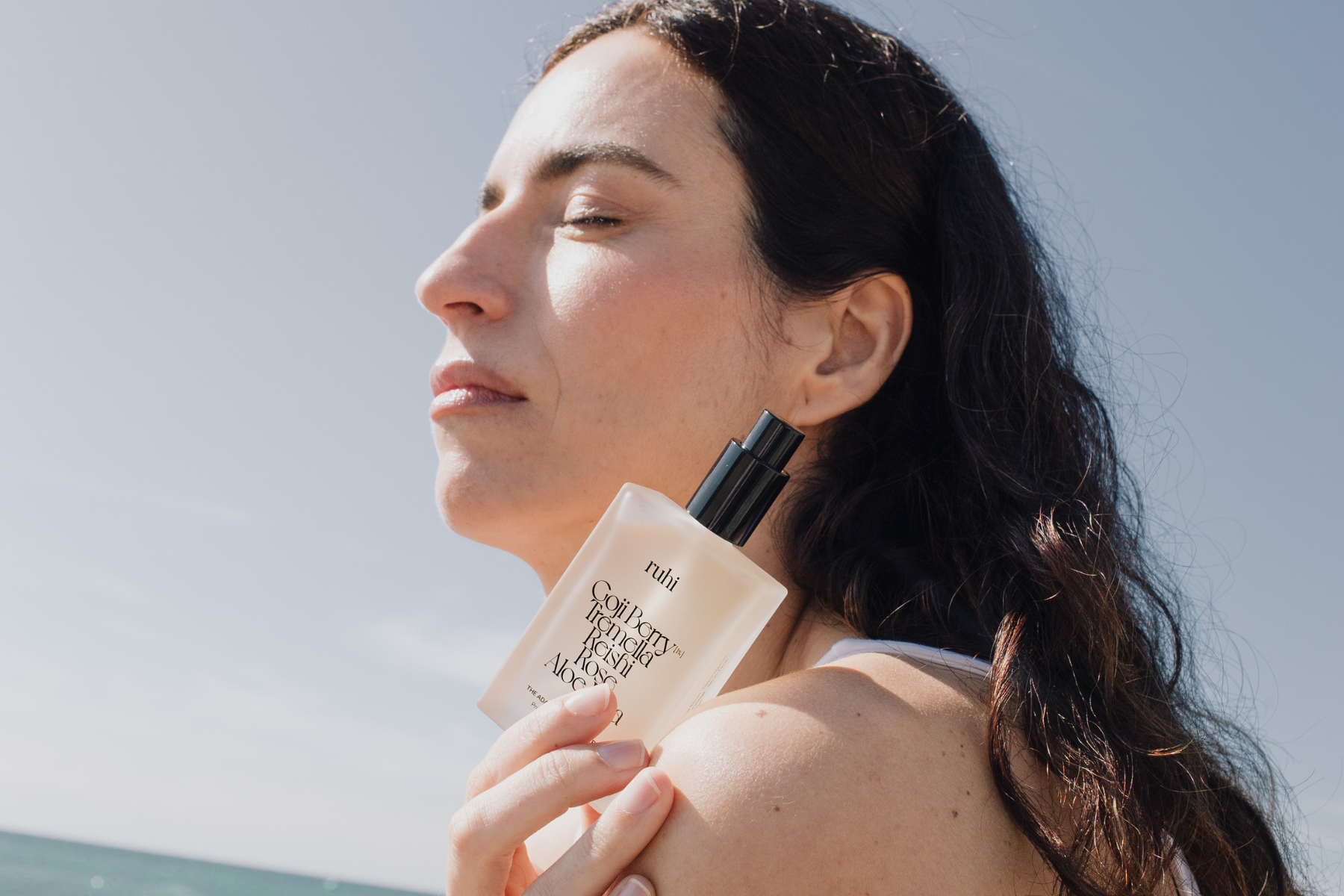
The new THE ADAPTOGEN RETINAL SERUM from ruhi, €69 for 30ml.
Application Tips for Skincare with Retinal
To achieve the best results and minimize potential skin irritation, you should proceed as follows:
Gradual Introduction:
Integrate the active ingredient slowly into your beauty routine. Two to three applications per week are a good start if you have no prior retinal experience. This gives your skin time to get used to the new active ingredient.
Apply in the evening:
Use the Retinal Serum in your evening skincare routine. This is recommended because retinoids can make your skin more sensitive to light.
Use Sun Protection:
For the same reason, it is advisable to apply additional sun protection during the day when using retinal in your skincare.
Good to know:
Retinal, like all other retinoids, should not be used during pregnancy and breastfeeding.
OUR CONCLUSION: RETINAL IS THE BETTER RETINOL
In the beauty battle of Retinol vs. Retinal, the latter emerges as the clear winner, especially in terms of efficacy and tolerability. Retinal's ability to convert to retinoic acid more quickly and efficiently leads to visible and gentle results in the shortest possible time. Furthermore, retinal has a lower irritation potential, making it an excellent choice for a variety of skin types, including sensitive skin. Our new Adaptogen Retinal Serum (coming soon) offers you the perfect opportunity to harness the benefits of this powerful ingredient and care for your skin gently and highly effectively.
SOURCES
[1] Siegenthaler G, Saurat JH, Ponec M. Retinol and retinal metabolism. Relationship to the state of differentiation of cultured human keratinocytes. Biochem J. 1990 Jun 1;268(2):371-8. doi: 10.1042/bj2680371. PMID: 2163611; PMCID: PMC1131442.
[2] Saurat JH, Didierjean L, Masgrau E, Piletta PA, Jaconi S, Chatellard-Gruaz D, Gumowski D, Masouyé I, Salomon D, Siegenthaler G. Topical retinaldehyde on human skin: biologic effects and tolerance. J Invest Dermatol. 1994 Dec;103(6):770-4. doi: 10.1111/1523-1747.ep12412861. PMID: 7798613.
[3] Kwon HS, Lee JH, Kim GM, Bae JM. Efficacy and safety of retinaldehyde 0.1% and 0.05% creams used to treat photoaged skin: A randomized double-blind controlled trial. J Cosmet Dermatol. 2018 Jun;17(3):471-476. doi: 10.1111/jocd.12551. Epub 2018 Apr 16. PMID: 29663701.
[4] Kim J, Kim J, Jongudomsombat T, Kim Bs E, Suk J, Lee D, Lee JH. The efficacy and safety of multilamellar vesicle containing retinaldehyde: A double-blinded, randomized, split-face controlled study. J Cosmet Dermatol. 2021 Sep;20(9):2874-2879. doi: 10.1111/jocd.13993. Epub 2021 Feb 18. PMID: 33569865.
https://pubmed.ncbi.nlm.nih.gov/33569865/
[5] Brown A, Furmanczyk M, Ramos D, Ribes A, Pons L, Bustos J, de Henestrosa ARF, Granger C, Jourdan E. Natural Retinol Analogs Potentiate the Effects of Retinal on Aged and Photodamaged Skin: Results from In Vitro to Clinical Studies. Dermatol Ther (Heidelb). 2023 Oct;13(10):2299-2317. doi: 10.1007/s13555-023-01004-z. Epub 2023 Aug 24. PMID: 37615835; PMCID: PMC10539272.
[6] Kwon HS, Lee JH, Kim GM, Bae JM. Efficacy and safety of retinaldehyde 0.1% and 0.05% creams used to treat photoaged skin: A randomized double-blind controlled trial. J Cosmet Dermatol. 2018 Jun;17(3):471-476. doi: 10.1111/jocd.12551. Epub 2018 Apr 16. PMID: 29663701.
[7] Saurabh Singh, Nidhi Majumdar, and Swastika Suvirya. Topical 0.05% retinaldehyde for the treatment of mild to moderate acne vulgaris. Indian Journal of Dermatology, Venereology, and Leprology (2013).
[8] Creidi P, Vienne MP, Ochonisky S, Lauze C, Turlier V, Lagarde JM, Dupuy P. Profilometric evaluation of photodamage after topical retinaldehyde and retinoic acid treatment. J Am Acad Dermatol. 1998 Dec;39(6):960-5. doi: 10.1016/s0190-9622(98)70270-1. PMID: 9843009.
[9] Vienne MP, Ochando N, Borrel MT, Gall Y, Lauze C, Dupuy P. Retinaldehyde alleviates rosacea. Dermatology. 1999;199 Suppl 1:53-6. doi: 10.1159/000051380. PMID: 10473962.