When probiotics are mentioned, most people probably think of nutritional supplements in the form of probiotic power drinks rather than cosmetics. But bacterial cultures are not only used internally to regenerate the intestinal flora. Probiotics can also do a great job when applied externally to the skin.
In recent years, probiotics have therefore developed into a popular ingredient in skincare products, and for good reason. In this article, we explain what these reasons are and what makes our innovative Probiotic Hyaluronic Serum so special.
What are probiotics?
Before we go into detail and look at how probiotic cosmetics can benefit our skin in the daily skincare routine, let's first clarify: What exactly are probiotics?
Definition
If we look at the etymology, i.e., the origin of the word, it quickly becomes clear: the name says it all. A probiotic (plural: probiotics) is composed of the Latin prefix pro ("for") and the Greek noun bios ("life"). This describes it quite aptly, because probiotics are understood to be living microorganisms such as bacteria (e.g., lactic acid bacteria) or yeasts.
They are often referred to as "good bacteria" because they can help restore or maintain the balance of natural microorganisms in the gut. These healthy bacteria are found in certain foods such as yogurt, fermented products, or nutritional supplements.
Nutritional supplements
The World Health Organization (WHO) therefore defines probiotics in relation to nutritional supplements as "living microorganisms which, when administered in adequate amounts, confer a health benefit on the host." [1]
Cosmetics
When probiotics are mentioned in skincare, the term refers to "viable microorganisms that have a cosmetic effect when applied to the skin or influence the skin microbiome." [2]

The skin microbiome
We will go into the cosmetic effects in more detail in the next step. First, however, we want to know: What is the skin microbiome all about?
Definition
The skin microbiome is also referred to as the skin flora. It refers to the community of microorganisms, including all bacteria, fungi, viruses, and other microbes, that exist on our skin surface. As a natural component of the skin, the microbiome plays a decisive role in maintaining its health and function. It interacts with the immune system and influences the skin barrier.
Just don't throw it out of balance
The microbiome varies from person to person and is structured differently depending on the skin area. Factors such as genetic predisposition, environmental conditions, personal hygiene practices, and diet can influence the composition of the microbiome. A healthy skin microbiome is characterized by a balanced diversity of microbes. An imbalance or change in composition can lead to various skin problems, such as inflammation, acne, eczema, and other dermatological conditions.
Time for a brief interim summary
So, let's summarize: Probiotics are viable microorganisms that can act on the skin microbiome. The skin microbiome (skin flora) is the totality of all microorganisms on the skin surface. A balanced skin flora is crucial for healthy skin.
And this is exactly where probiotic-enriched skincare comes in:
Probiotic cosmetics and their benefits for the skin
Probiotic skincare promotes the natural skin flora to maintain the healthy balance of the skin. This happens in various ways, for example by strengthening the skin barrier, anti-inflammatory properties, and protection against pathogenic microorganisms. [3]
Strengthening the skin barrier
An intact skin barrier is essential to lock in moisture and ward off harmful environmental influences. A strengthened skin barrier thus leads to better hydration and reduces visible signs of dryness. Probiotics can strengthen the skin barrier by stimulating the production of ceramides (skin's own lipids) [4], which are crucial for maintaining barrier function.
Soothing sensitive skin
Probiotics have anti-inflammatory properties and can help soothe skin problems such as acne, rosacea, or eczema. They regulate the skin's immune response and reduce the release of pro-inflammatory factors, which can reduce redness and irritation.
Skin regeneration
Probiotics can support cell renewal and the skin's healing process. They promote the production of collagen and elastin, which are important for skin firmness and elasticity. The result: fewer fine lines and wrinkles – slow-aging at its best.
Protection against harmful environmental influences
Our skin is exposed daily to harmful environmental influences such as UV radiation, pollution, and oxidative stress. Probiotics can act as antioxidants and neutralize free radicals [5] that are caused by these environmental influences. This helps prevent premature skin aging and protect the skin from damage.
Enough good reasons to develop our own hyaluronic serum with an innovative probiotic active ingredient:

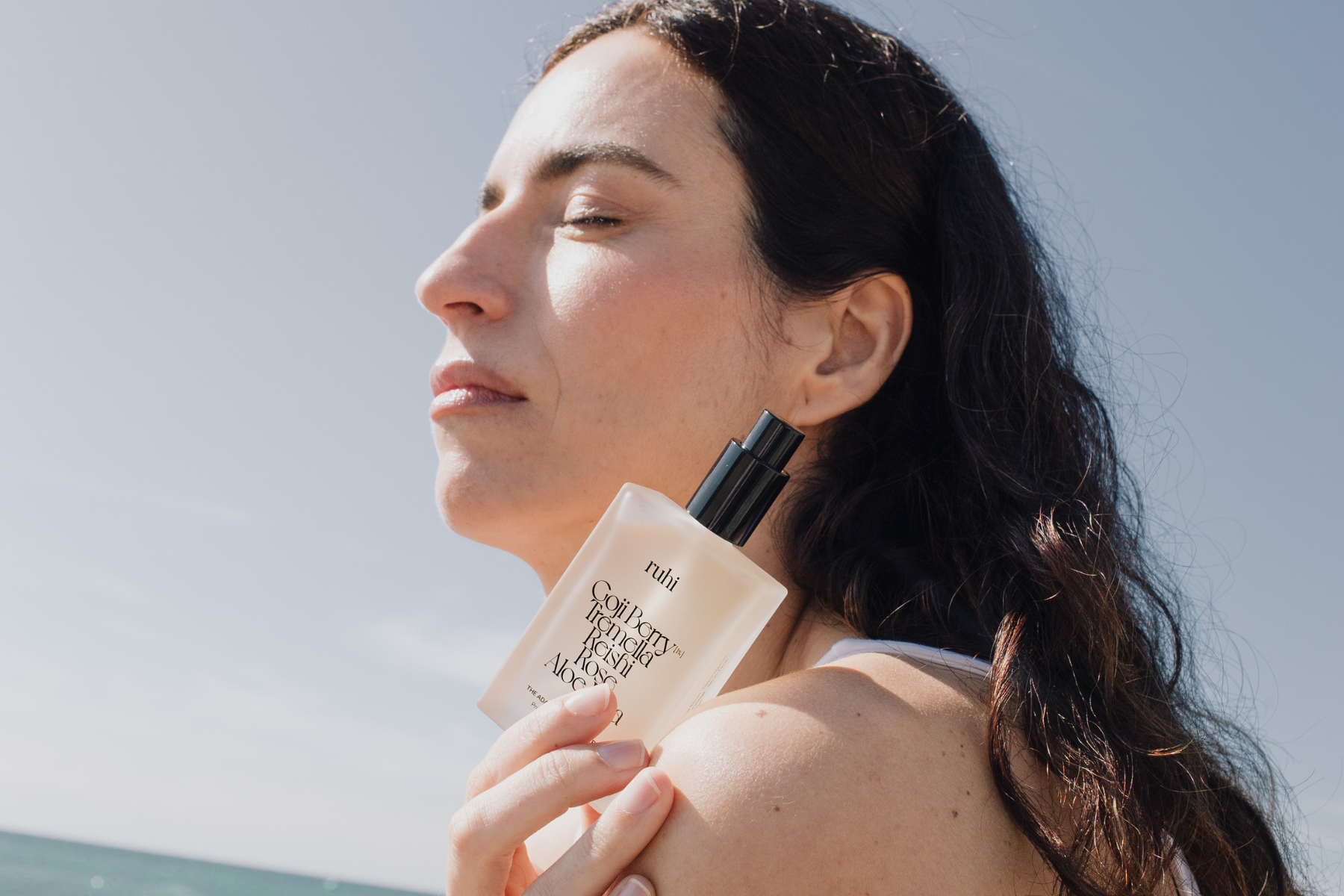
What's special about ruhi Probiotic Hyaluronic Serum
The Probiotic Hyaluronic Serum is primarily a highly effective moisturizing serum thanks to four different types of hyaluronic acid. But we thought, why limit ourselves to just one active complex when so much more can be gotten out of the same product? No sooner said than done:
Cosmetics with live cultures – a challenge
As already mentioned above, probiotics are generally associated with living microorganisms. In the field of skincare, this can sometimes be misleading. This is because many cosmetic products only contain components of bacterial cultures that are no longer viable, but still declare them as probiotics.
This is because it is a major challenge to ensure the quality and stability of living microorganisms. This applies to both the manufacturing process and the finished cosmetic product. For example, the bacterial strains used must not multiply, otherwise the product could spoil.
Ruhi has successfully met precisely this challenge, and with that, we come to the special feature of our multifunctional organic hyaluronic serum:
Live probiotic cultures for more effectiveness
In addition to hyaluronic acid, extract from the silver ear mushroom, white tea, willow bark, and aloe vera, our serum exclusively contains live bacterial cultures. This allows the serum to interact even more effectively with the skin and improves its natural protective function by up to 77%. [6]
Award-winning: Our innovative probiotic active ingredient
Lactobacillus Ferment is the 100% natural probiotic extract we use for our hyaluronic serum. The novelty lies in the fact that, for the first time, its bacterial structure has been successfully preserved in a cosmetic formulation through a specially developed process. By means of controlled heat treatment and subsequent spray drying, the membrane remains intact, allowing all metabolic products of the bacteria to be transported. For this innovation, our ingredient was even awarded the BSB Innovation Award in the Active Ingredients category.
What our probiotic active ingredient does
The live probiotic cultures in our hyaluronic serum demonstrably activate the skin's natural protective function: [6]
Strengthening the skin barrier
A significant increase in filaggrin production (protein in the upper skin layer) leads to a strengthening of the skin barrier and better hydration of the epidermis.
Regulation of sensitive skin
Redness is reduced by up to 45%.
Reduction of skin dryness
From seven days after the start of treatment with the serum, skin moisture noticeably improves. After just three days, skin dryness is visibly and sustainably reduced by -8.8%.
Protection against environmental damage
Damage to the skin barrier caused by fine dust is reduced by 45%.
Conclusion: What can probiotic skincare achieve?
Cosmetics enriched with probiotics help keep the skin flora in a healthy balance. This strengthens the skin's barrier function, making it less susceptible to harmful external influences and promoting moisture retention. Thus, skincare with microbiome-strengthening probiotics is an excellent slow-aging formula in the long run.
Sources
[1] Hill, C., Guarner, F., Reid, G. et al. The International Scientific Association for Probiotics and Prebiotics consensus statement on the scope and appropriate use of the term probiotic. Nat Rev Gastroenterol Hepatol 11, 506–514 (2014). doi.org/10.1038/nrgastro.2014.66https://doi.org/10.1038/nrgastro.2014.66
[2] J. Finke, L. Holsten, B. Kästle, A. Keck-Wilhelm, R. Simmering. Haut-Mikrobiom und Kosmetik – eine Bestandsaufnahme. Deutsche Gesellschaft für Wissenschaft und angewandte Kosmetik e.V. (DGK) (2022). https://dgk-ev.de/wp-content/uploads/2022/06/Microbiom.pdf
[3] Huang M-CJ, Tang J. Probiotics in personal care products. Microbiology Discovery. 2015;3(1):5. [DOI: 10.7243/2052-6180-3-5].
[4] Di Marzio L, Cinque B, De Simone C, Cifone MG. Effect of the lactic acid bacterium Streptococcus thermophilus on ceramide levels in human keratinocytes in vitro and stratum corneum in vivo. J Investig Dermatol. 1999;113:98–106.
[5] Wang, Y.; Wu, Y.; Wang, Y.; Xu, H.; Mei, X.; Yu, D.; Wang, Y.; Li, W. Antioxidant Properties of Probiotic Bacteria. Nutrients 2017, 9, 521. https://doi.org/10.3390/nu9050521.
[6] SymRebootTM L19. Lactobacillus plantarum HEAL19. True biotic totum bacterium technology. Symrise 2019.