A radiant complexion and youthfully plump skin at any age – that's what we all wish for. One active ingredient that promises to fulfill this dream has particularly stood out in recent years: hyaluronic acid. It is considered a true miracle cure against wrinkles and is therefore now an integral part of many skincare products. But what exactly is hyaluronic acid, what benefits does it have for our skin, and what's really behind the slow-aging promise? Ready for a deep dive into the world of skincare with hyaluronic acid? Then let's dive in!
What is hyaluronic acid?
Hyaluronic acid, also known as hyaluron or hyaluronan, is a polysaccharide, i.e., a multiple sugar. The term is derived from the ancient Greek word 'hyalos', which means 'glass' or 'glassy' in English and refers to the presence of hyaluronic acid in the vitreous humor of the human eye.
But that's not the only place it appears in our body. It is also found in our skin, in tendons and ligaments, in connective tissue, and in our joints, where it serves as a lubricant. Hyaluronic acid is therefore a natural, endogenous substance, which means it is very well tolerated.
What are the properties of hyaluronic acid?
Hyaluronic acid has several properties that make it a popular ingredient in skincare products [1]:
The superpower of hyaluronic acid is that it can bind many times its own weight in water. This makes it an important water reservoir for the skin.
A higher concentration of hyaluronic acid also promotes the growth and movement of fibroblasts, the cells responsible for the production of collagen and elastin. This gives the skin more firmness and elasticity.
Additionally, hyaluronic acid also acts as a protectant for fibroblasts by scavenging free radicals and thus preventing premature skin aging.
In summary, it can be said that hyaluronic acid
- binds moisture, which plumps the skin and smooths small wrinkles.
- stimulates collagen and elastin production, which gives the skin elasticity.
- acts as an antioxidant and thus protects against oxidative stress and free radicals.

Hyaluronic acid and skin aging
With age, the proportion of the skin's own hyaluronic acid steadily decreases, and with it, the positive effects described above.[2] The reduced water-binding capacity means that optimal moisture supply is no longer ensured.
The skin dries out, the uppermost skin layer sags, loses elasticity and firmness, and fine lines and unwanted wrinkles appear.
In addition, without sufficient hyaluronic acid, the formation and storage of collagen, another crucial factor for firm skin, is also hindered.
The decreasing hyaluronic acid level in the skin with age therefore leads to:
- Reduced water-binding capacity
- Moisture loss
- Dryness and dehydration
- Loss of skin volume and firmness
- Formation of wrinkles and fine lines
The goal of skincare with hyaluronic acid is therefore to restore the hyaluronic acid content in the skin to the level of younger years.
What types of hyaluronic acid are there?
Not all hyaluron is the same. A distinction is made between three types of skin-identical hyaluronic acids, which are measured by their molecular weight. This is calculated in the mass unit KiloDalton (kDa), where 1 KiloDalton corresponds to 1000 Daltons.
This results in the subdivision into [3]:
- Low-molecular weight or short-chain hyaluronic acid (10-250 kDa)
- Medium-molecular weight or medium-chain hyaluronic acid (250-1000 kDa)
- High-molecular weight or long-chain hyaluronic acid (from 1000 kDa)
Where and how do the different hyaluronic acids work in the skin?
Short-chain hyaluronic acid
Low-molecular weight hyaluronic acid has the smallest molecular size, can therefore penetrate more easily into the deeper skin layer (dermis) and helps to retain moisture. It acts as a moisture booster that hydrates the skin from within. This makes it appear firmer and plumper and reduces wrinkles. In addition, with regular use, hyaluronic acid stimulates cells to produce their own hyaluronic acid.
With these properties, low-molecular weight hyaluronic acid has even made it onto the list of "Dermocosmetics against skin aging" of the Society for Dermopharmacy (GD).[4] This gives it the status of an officially recognized anti-aging active ingredient and makes skincare with hyaluronic acid a proven remedy against premature skin aging.
Medium-chain hyaluronic acid
This form has a slightly larger molecular size and can therefore not work in the depth, but only penetrate into the upper skin layers of the epidermis. There, it ensures better moisture binding, which plumps up the skin, improves the complexion, and reduces wrinkle depth.
Long-chain hyaluronic acid
High-molecular weight hyaluronic acid has the largest molecular size and therefore cannot penetrate the skin. It forms a protective film on the skin's surface, thereby preventing moisture loss and protecting the skin from environmental influences and free radicals.
Let's summarize once again:
- Short-chain hyaluronic acid deeply moisturizes the skin and gives it more elasticity from within.
- Medium-chain hyaluronic acid enhances moisture binding in the upper skin layer, which refines the complexion and evens out fine lines.
- Long-chain hyaluronic acid forms a moisturizing film on the skin's surface, which has a smoothing effect and simultaneously protects against dehydration and external influences.

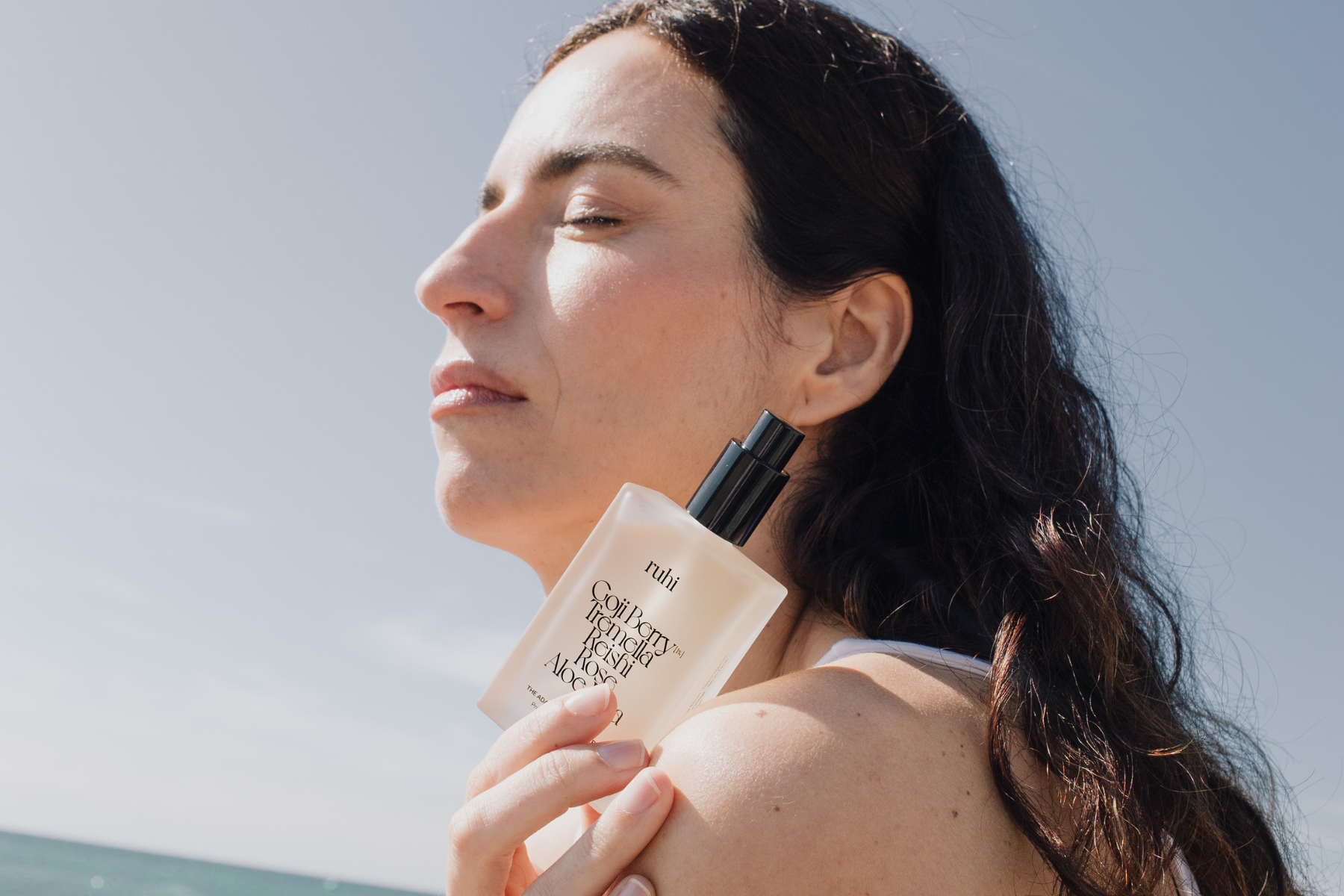
ruhi's Hyaluronic Serum with three types of hyaluronic acid
A mixture of all three types of hyaluronic acid in skincare combines the immediate effects of high- and medium-molecular hyaluron with the long-term effect of low-molecular hyaluronic acid. For full effectiveness, our Probiotic Hyaluronic Serum therefore contains both short-, medium-, and long-chain vegan hyaluronic acid of the highest biotechnological quality.
This not only moisturizes your skin but also protects it from moisture loss. It is plumped up from within, which reduces fine lines and wrinkles and counteracts premature skin aging. This makes our Ruhi Hyaluronic Serum a highly effective slow-aging formulation.
Plant-based hyaluronic acid alternative from the Tremella mushroom
In addition, the organic hyaluronic serum contains extract from the Tremella mushroom, also known as Tremella fuciformis. This medicinal and edible mushroom, widely used in Japan and China, is a fascinating plant-based hyaluronic alternative. It contains polysaccharides that form a film on the skin's surface, increasing water-binding capacity and maintaining water content in the skin. Furthermore, Tremella mushroom extract has strong antioxidant properties, thus protecting against free radicals.
How to use ruhi's Probiotic Hyaluronic Serum
The hyaluronic serum is suitable for use at any time of day, whenever your skin needs a little moisture boost. It is best applied in the morning under your face oil or cream to ensure optimal hydration throughout the day. First, cleanse your facial skin with some water before gently massaging four to five drops into the skin as needed.
Conclusion: Yes to skincare with hyaluronic acid
We can now definitively answer "yes" to our initial question of whether hyaluronic acid can live up to its slow-aging promise. Its ability to bind large amounts of water enables it to intensely hydrate the skin, making it appear plumper and more youthful. By promoting collagen production, hyaluronic acid helps improve skin structure and reduce the appearance of fine lines and wrinkles. Furthermore, it offers protection against harmful environmental influences and can thus help slow down skin aging.
Sources
[1] Fritz, K. The Biorevitalization of the Skin with Native Hyaluronic Acid. Aktuelle Dermatologie 32(3). https://www.thieme-connect.com/products/ejournals/pdf/10.1055/s-2005-921142.pdf
[2] Lautenschläger, H. Hyaluronic Acid in Skin Care. Chem. Unserer Zeit, 56. 2022. https://doi.org/10.1002/ciuz.202110013
[3] Cyphert J./Trempus C./Garantziotis S. Size Matters: Molecular Weight Specificity of Hyaluronan Effects in Cell Biology. Int J Cell Biol., 563818. 2015.Size Matters: Molecular Weight Specificity of Hyaluronan Effects in Cell Biology (hindawi.com)
[4] Gesellschaft für Dermopharmazie (GD). Dermocosmetics against skin aging. Guideline of the GD Gesellschaft für Dermopharmazie e. V. 2017. GD_LL_Dermokosmetika_gegen_Hautalterung_13.03.2017.pdf (gd-online.de)